


Walk through any modern construction site, automobile factory, furniture manufacturing unit, or engineering facility, and you will find metal tubes playing an important role. These tubes may look simple, but producing them accurately and consistently requires sophisticated manufacturing technology.
This is where the Tube Mill Machine comes into the picture. Over the years, tube manufacturing has progressed from basic mechanical forming methods to automated production lines capable of forming, welding, sizing, cutting, and inspecting tubes at high speed.
One of the most significant developments in this journey has been the ERW Tube Mill Machine. By combining continuous roll forming with electrical resistance welding, ERW technology has changed the way manufacturers produce welded steel tubes.
But how did tube mills reach this stage, and what will happen next? Let us explore the past, present, and future of tube manufacturing.
The early production of metal tubes was much more labor-intensive than it is today. Manufacturers worked with metal sheets or strips and used mechanical methods to form them into cylindrical shapes. Joining the edges was another challenging stage.
Production was relatively slow, and achieving consistent dimensions required considerable operator involvement.
As industrialization expanded, industries began demanding larger quantities of standardized tubes. Construction, transportation, machinery, agriculture, and infrastructure projects all needed reliable tubular products.
This demand encouraged manufacturers to develop continuous forming technologies.
The concept was straightforward but revolutionary: instead of manufacturing one tube at a time, a continuous strip could be progressively shaped through a series of rollers.
That basic idea eventually became the foundation of the modern Tube Mill Machine.
Continuous roll forming dramatically improved manufacturing productivity. A flat metal strip could enter one end of the production line and gradually become a round, square, rectangular, or other tubular profile.
Each forming stand performed a specific part of the shaping process.
This approach provided several important advantages:
As technology progressed, welding was integrated directly into the production line.
The development of electrical resistance welding was a major milestone in tube manufacturing.
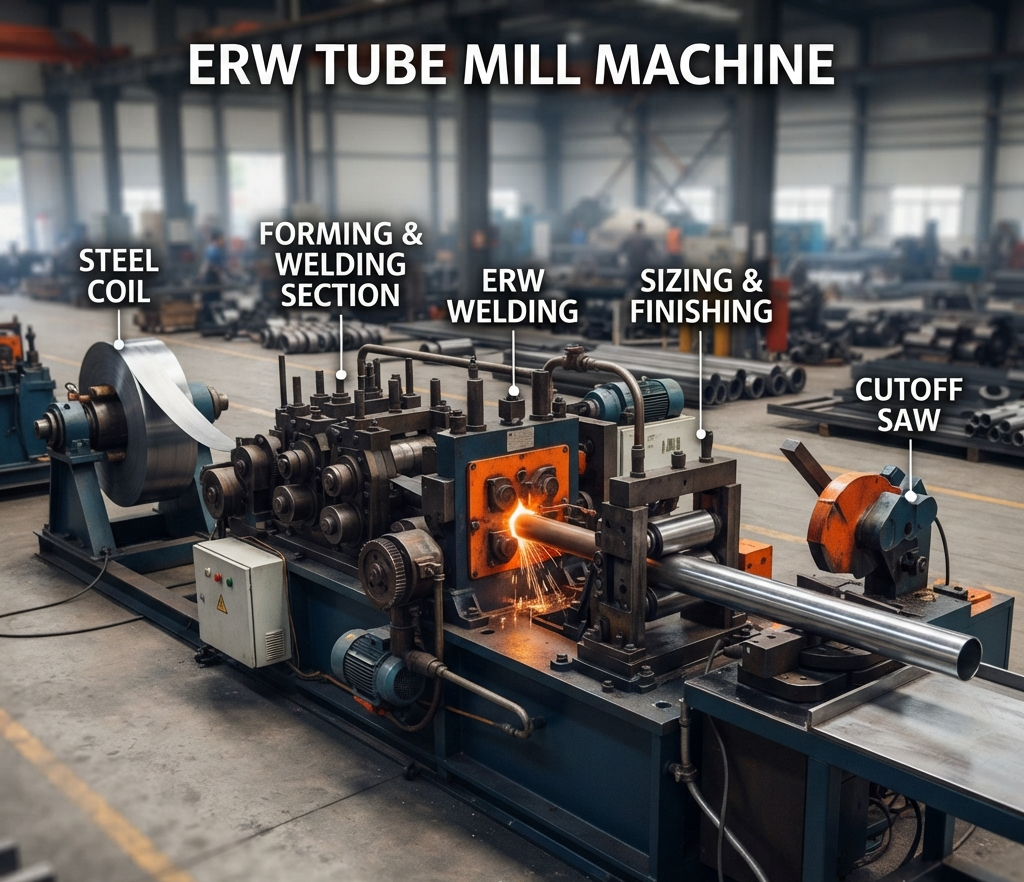
An ERW Tube Mill Machine forms a metal strip into the desired tubular shape and joins the edges through electrical resistance welding. Heat is generated by electrical current at the joining area, while pressure helps create the weld.
Because welding takes place continuously as the strip moves through the mill, manufacturers can achieve high production rates.
A typical ERW production line can contain several integrated sections, including:
The combination of these stages makes ERW technology suitable for many large-scale manufacturing operations.
The popularity of ERW manufacturing is closely connected with productivity and consistency.
Industries that require large volumes of welded tubes need a process that can operate continuously while maintaining acceptable dimensional and weld quality.
ERW tubes are commonly used in applications involving:
The exact suitability of an ERW tube depends on its material, dimensions, wall thickness, manufacturing standard, and intended application.
People sometimes use these two terms as though they mean exactly the same thing. They are related, but there is a distinction.
| Factor | Tube Mill Machine | ERW Tube Mill Machine |
| Meaning | General tube manufacturing machine | Tube mill using electrical resistance welding |
| Forming | Usually roll forming | Roll forming |
| Welding | Depends on machine design | Resistance welding |
| Production | Varies by technology | Continuous production |
| Automation | Basic to advanced | Frequently highly automated |
| Typical application | Different tube manufacturing processes | Welded steel tube production |
In simple terms, an ERW mill is a specific type of tube mill designed around resistance welding.
Today’s Tube Mill Machine is not simply a set of mechanical rollers. It is increasingly an integrated manufacturing system.
Modern production lines can use programmable logic controllers, sensors, servo drives, digital interfaces, and automated monitoring.
Operators can monitor important parameters such as:
These technologies can reduce unnecessary manual adjustments and help manufacturers maintain consistent production conditions.
Automation is one of the most important trends influencing tube manufacturing.
Modern factories are moving toward systems where machines can collect production data and respond to changing conditions with limited operator intervention.
For example, sensors can monitor machine temperature, vibration, speed, electrical characteristics, and other operating conditions.
This information can help manufacturers identify unusual behavior before it becomes a major production problem.
The result is a move from traditional maintenance toward predictive maintenance.
Unexpected equipment failure can be expensive. A breakdown can stop production, delay deliveries, and increase maintenance costs.
Predictive maintenance attempts to identify potential failures before they occur.
A future ERW Tube Mill Machine could continuously analyze information from motors, bearings, welding equipment, forming stands, and other components.
When unusual patterns appear, maintenance teams may receive an early warning.
This approach could help manufacturers:
Another exciting development is the use of artificial intelligence and machine vision.
Traditional inspection often depends on sampling or operator observation. Modern camera-based systems can inspect products continuously.
Future AI-supported systems could help identify:
AI is unlikely to eliminate the need for skilled manufacturing professionals. Instead, it can provide them with more information and faster feedback.
Energy efficiency is becoming increasingly important across manufacturing industries.
Future tube mills are expected to use more efficient motors, improved drives, optimized welding systems, and intelligent power management.
Reducing energy consumption can provide both environmental and economic benefits.
Manufacturers are also likely to focus on reducing scrap. Better forming accuracy, improved process control, and automated inspection can help prevent defective products from consuming unnecessary raw material.
Customer requirements are changing rapidly. A manufacturer may need to produce several tube sizes or specifications instead of running one product continuously.
This means future Tube Mill Machine systems will need greater flexibility.
Technologies that support fast changeovers, digital production recipes, automated settings, and modular tooling can help manufacturers respond more quickly to different orders.
The ability to change production efficiently could become just as important as maximum production speed.
The tube mill of the future is likely to be highly connected.
Instead of operating as an isolated production machine, it may communicate with enterprise software, quality-control systems, maintenance platforms, and production-management systems.
A future production line could potentially:
This represents a shift from mechanical manufacturing toward intelligent manufacturing.
Businesses planning to purchase or upgrade a tube mill should consider future requirements rather than focusing only on current production.
Important factors include:
A machine that meets today’s requirements but cannot adapt to tomorrow’s demands may become a limitation as the business grows.
A Tube Mill Machine is production equipment used to continuously form metal strip into tubes. Depending on the configuration, the line may also include welding, sizing, cutting, straightening, and inspection.
An ERW Tube Mill Machine forms metal strip into a tubular shape and joins its edges through electrical resistance welding.
ERW technology supports continuous production and can provide high productivity with controlled welding and forming processes.
Construction, automotive, furniture, agriculture, infrastructure, machinery, and general engineering are among the industries that use ERW tubes.
Yes. Depending on their configuration and tooling, tube mills can produce round, square, rectangular, and other profiles.
Many modern systems use PLC controls, sensors, servo drives, automated cutting, digital monitoring, and other automation technologies.
Predictive maintenance uses equipment data to identify potential problems before they develop into major failures.
Yes. AI and machine vision can potentially support defect detection, quality inspection, process monitoring, and predictive maintenance.
Energy efficiency is expected to become increasingly important through improved motors, drives, welding systems, process optimization, and reduced material waste.
Consider material type, tube dimensions, production speed, welding requirements, automation, tooling, quality control, energy consumption, maintenance, and future expansion.
Read more – https://tandtlawassociates.com/past-and-future-of-erw-tube-mill-line-and-tube-mill-line/
https://newsgrow.blogspot.com/2026/08/erw-tube-mill-line-and-tube-mill-line.html
https://tandtlawassociates.com/tube-mill-machine-and-erw-tube-mill-machine-past-present-and-future/