


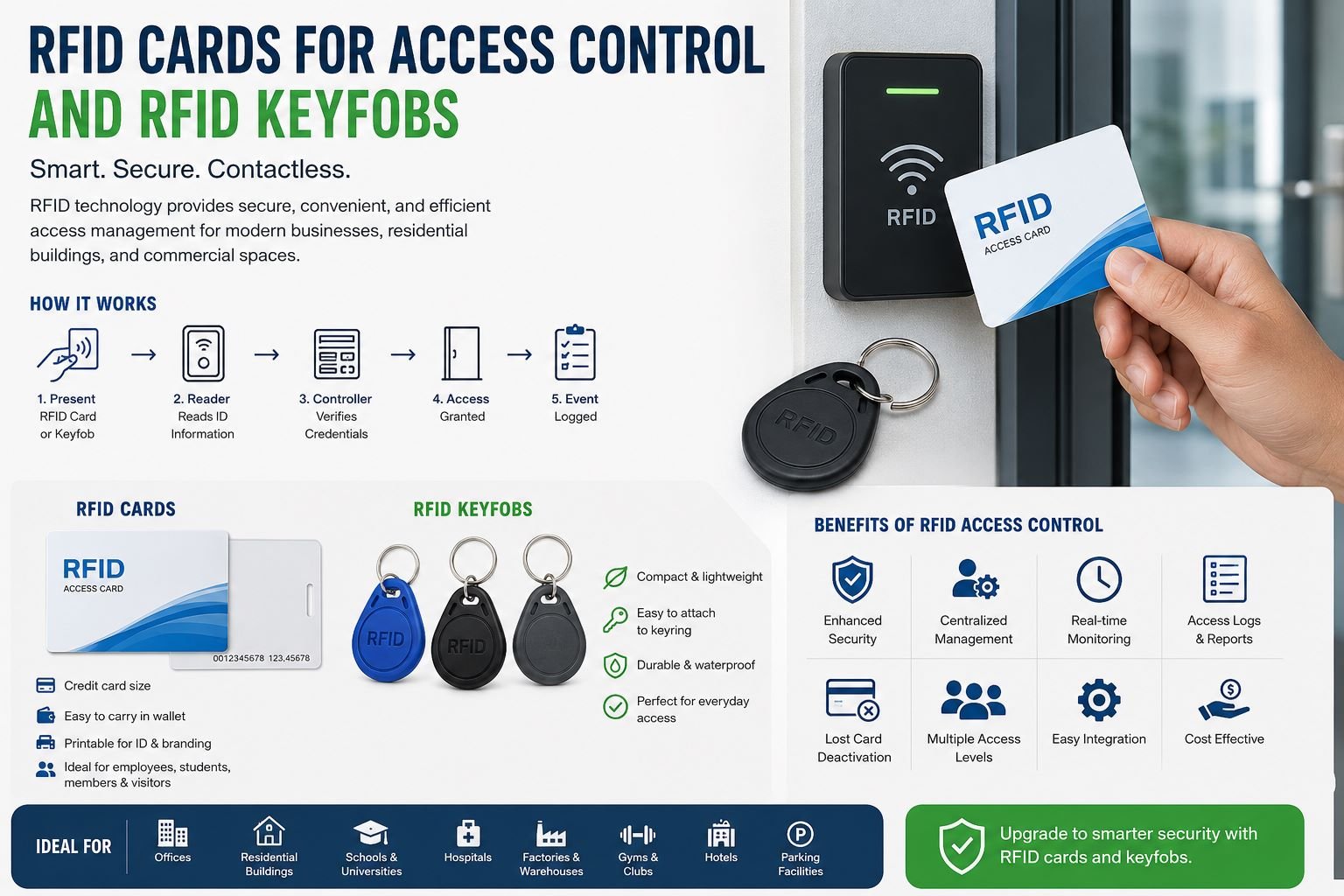
Access control is no longer limited to locks, keys, and security personnel. Modern facilities require systems capable of identifying individuals, determining their permissions, recording access events, and immediately removing authorization when necessary. RFID technology provides an effective infrastructure for accomplishing these tasks.
RFID cards for access control and RFID keyfobs are two widely used physical credentials within electronic access control systems. Although they may appear simple externally, their operation involves radio-frequency communication, credential identifiers, readers, controllers, databases, authentication protocols, and electronic locking hardware.
Understanding these elements is essential when selecting RFID credentials because appearance alone does not determine compatibility or security.
An RFID access control installation typically consists of several interconnected components.
The credential identifies the user. The RFID reader communicates with that credential. A controller processes the information, while access control software determines permissions. Finally, an electronic locking device physically controls the doorway.
The authentication sequence generally follows this process:
This entire sequence can occur almost instantly.
RFID cards for access control are specifically designed to act as electronic identity credentials. Depending on the technology, a card may contain a unique identifier and additional memory or security capabilities.
Their card format also provides space for visual identification.
Organizations can print:
This makes RFID cards particularly useful when both visual identification and electronic access authorization are required.
RFID keyfobs use the same broad RFID principle but package the credential technology inside a small keyring-style enclosure.
Inside a typical passive keyfob are an integrated circuit and antenna. The credential generally does not require its own battery. Instead, it obtains energy from the electromagnetic field produced by a compatible reader.
Once energized, the credential communicates according to its supported technology.
Because keyfobs are compact, they are particularly practical for apartments, parking systems, fitness facilities, offices, warehouses, gated communities, and membership-based environments.
Frequency is one of the most important technical considerations when selecting RFID credentials.
Many traditional proximity access systems operate around 125 kHz.
These systems are commonly designed for short-range identification and straightforward access applications. Various credential technologies can exist within this frequency range, so frequency alone should never be treated as proof of compatibility.
13.56 MHz technology is widely associated with contactless smart cards and more sophisticated credential platforms.
Depending on the selected technology, high-frequency credentials may support additional memory, authentication mechanisms, cryptographic functionality, or multiple applications.
This distinction is critical.
A 13.56 MHz credential does not automatically work with every 13.56 MHz reader. The reader and credential must support compatible standards, protocols, chip technologies, data formats, and authentication methods.
Organizations purchasing RFID cards for access control should therefore verify the complete technical specification rather than simply ordering according to frequency.
Not all RFID technologies provide the same security level.
Some legacy access systems primarily rely on credential identifiers. More advanced architectures can use authentication and cryptographic mechanisms designed to provide stronger protection.
Security decisions should consider the sensitivity of the protected environment.
A low-risk communal entrance may have different requirements from a pharmaceutical laboratory, server room, research facility, financial institution, or critical infrastructure environment.
Higher-security applications can combine RFID credentials with additional authentication factors, such as:
The objective is to build security around risk rather than assuming every doorway requires identical protection.
One major advantage of electronic credentials is that possession does not necessarily mean unrestricted access.
Consider an organization with five departments.
A general employee might have access to the entrance and office floor. IT personnel could additionally enter server areas. Finance employees might access accounting rooms, while senior security personnel receive broader permissions.
The same principle can apply to RFID keyfobs.
Permissions can potentially be configured according to:
This creates a structured authorization model that is difficult to achieve with conventional keys.
| Factor | RFID Cards | RFID Keyfobs |
| Credential size | Card-sized | Compact |
| Carrying method | Wallet/lanyard | Keyring |
| Photo printing | Excellent | Generally unavailable |
| Branding area | Large | Limited |
| Employee identification | Excellent | Limited |
| Portability | High | Very high |
| Access permissions | Configurable | Configurable |
| Typical environments | Corporate, education, healthcare | Residential, parking, gyms |
| Replacement | Easily managed | Easily managed |
| Compatibility | Reader-dependent | Reader-dependent |
Neither format is inherently superior. The underlying credential technology and system architecture are more important than the physical shape.
Traditional keys provide limited information after an event. Finding an unlocked door does not necessarily reveal which authorized person previously entered.
Electronic access control can provide significantly better visibility.
Depending on system configuration, access logs may record the credential, door, timestamp, and whether access was accepted or rejected.
This information can assist with security investigations, operational monitoring, compliance processes, and access reviews.
However, organizations should establish appropriate privacy, data-retention, and access-log policies based on applicable requirements.
Credential management should cover the entire lifecycle rather than only initial issuance.
A typical lifecycle includes:
If an employee leaves, their RFID cards for access control can normally be disabled without collecting or replacing every other user’s credential.
Similarly, lost RFID keyfobs can be removed from the authorized credential database and replaced.
This centralized lifecycle management represents a major operational advantage over mechanical key systems.
Organizations should evaluate several factors before purchasing credentials.
Identify the exact reader model, supported frequencies, credential technologies, and communication protocols.
Determine whether the application needs simple identification or stronger credential authentication.
Consider moisture, dust, temperature, physical impact, outdoor exposure, and daily handling.
Employees wearing identification badges may benefit from cards, while residents or gym members may prefer keyfobs.
Consider whether the system may later expand to additional doors, locations, users, visitor management, attendance systems, or other applications.
They are contactless credentials used by compatible electronic access systems to identify users and evaluate their entry permissions.
The information varies by technology and may include identifiers, memory-based data, or information used during authentication.
Many common access-control keyfobs are passive credentials and therefore operate without an internal battery.
Reading distance varies according to frequency, credential technology, reader design, antenna, environment, and system configuration.
It may until administrators deactivate it. Lost credentials should therefore be reported and disabled quickly.
Yes. Access software can assign authorized credentials to multiple doors, zones, or facilities.
They can be integrated with compatible attendance or workforce-management systems where appropriate.
Their security depends primarily on the underlying credential technology and access system rather than the keyfob’s physical shape.
Yes. They may use different protocols, chips, data formats, standards, or authentication methods.
Yes. Depending on the platform, integration may include biometrics, alarms, visitor systems, video surveillance, and other security applications.
https://newsgrow.blogspot.com/2026/08/from-pocket-sized-tools-to-digital.html
https://freeseobacklinks.online/why-nfc-tags-and-smart-wristbands-are-changing-the-future-of-events/
https://blogstream.net/event-technology-enters-a-new-phase-as-nfc-wristbands-gain-wider-attention/
https://newsgrow.blogspot.com/2026/08/nfc-tag-china-market-advances-as-nfc.html