


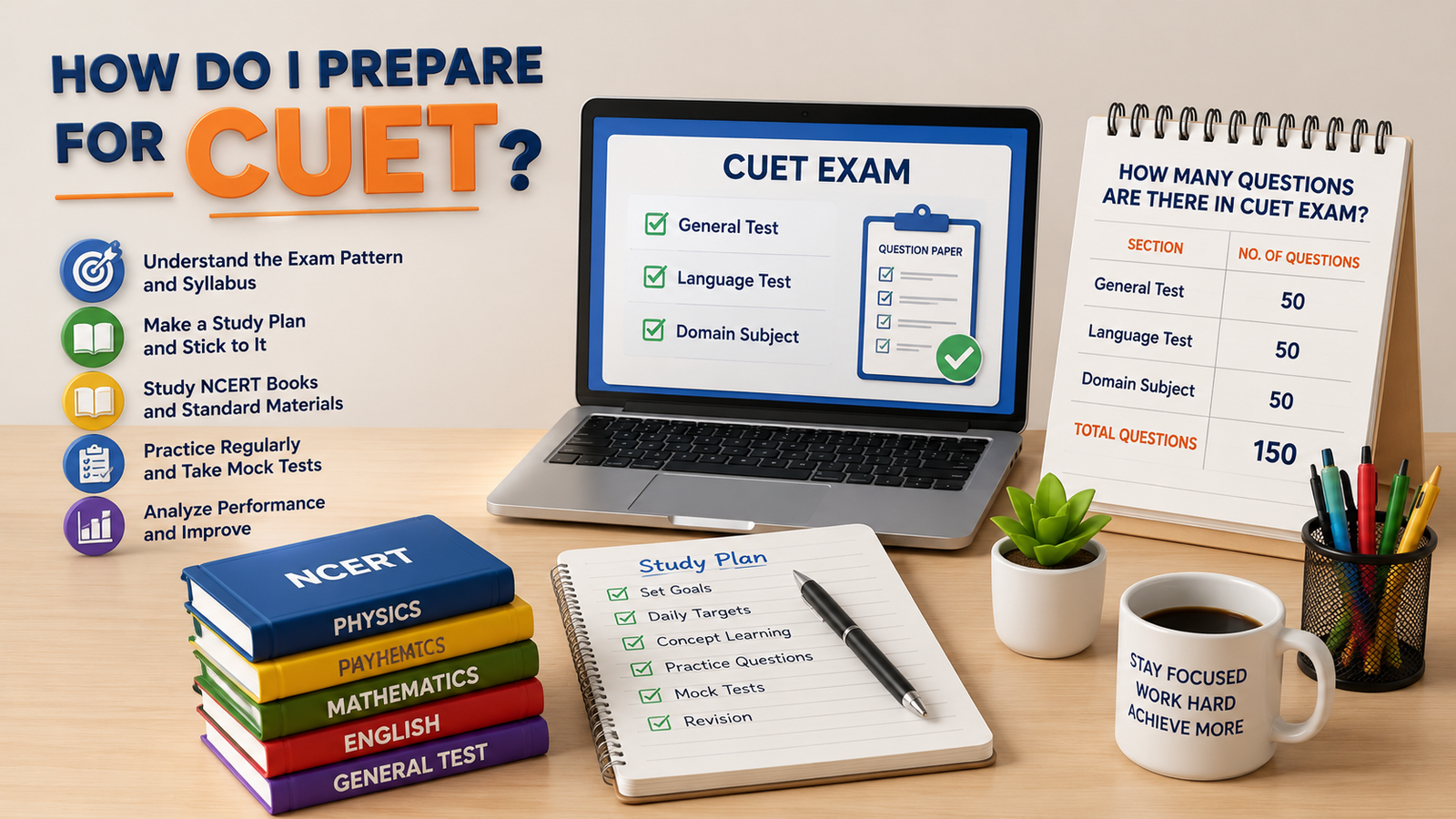
Preparing for the Common University Entrance Test requires more than simply studying Class 12 textbooks. Students need a clear understanding of the syllabus, exam pattern, time management, question difficulty, and regular practice. If you are wondering how do I prepare for CUET or how many questions are there in CUET exam, the right strategy begins with understanding the latest examination structure.
According to the official CUET UG 2026 Information Bulletin, each test paper contains 50 compulsory questions, and candidates receive 60 minutes for each test paper. Every correct answer carries five marks, while one mark is deducted for an incorrect response.
CUET UG is conducted by the National Testing Agency for admission to undergraduate programmes offered by Central Universities and other participating universities in India. The 2026 examination is conducted in Computer-Based Test mode. Candidates can choose a maximum of five subjects, including language papers and the General Aptitude Test, depending on the eligibility requirements of their chosen university and programme.
The examination currently covers 37 subjects: 13 languages, 23 domain-specific subjects and one General Aptitude Test. Domain subjects are primarily based on the NCERT syllabus, while language papers assess reading comprehension, literary aptitude and vocabulary.
Understanding these components allows students to create a more focused preparation strategy.
Students frequently ask how many questions are there in CUET exam because knowing the question count helps them plan their speed.
For CUET UG 2026, the official pattern is:
| Exam Feature | CUET UG 2026 Pattern |
| Questions per test paper | 50 |
| Questions compulsory | All 50 |
| Duration | 60 minutes per paper |
| Correct answer | +5 marks |
| Incorrect answer | -1 mark |
| Exam mode | Computer-Based Test |
| Maximum subjects | 5 |
These rules are confirmed in the official NTA Information Bulletin.
With 50 questions in 60 minutes, students theoretically have slightly more than one minute per question. However, some questions may require calculations or detailed reading, making time management essential.
Students asking how do I prepare for CUET should begin by creating a preparation strategy based on their selected subjects rather than following a single generic timetable.
Your first priority should be understanding your target university’s eligibility conditions and subject requirements. Choosing unnecessary subjects can increase your workload without improving your admission chances.
After finalising your subjects, follow these steps:
Consistency is usually more effective than studying for extremely long hours only during the final few weeks.
For domain-specific subjects, the official CUET UG 2026 bulletin states that the syllabus follows the NCERT syllabus.
Therefore, students should avoid immediately jumping into dozens of reference books.
Start with NCERT textbooks and focus on:
Once your fundamentals are strong, move to CUET-specific MCQs, sample papers and mock examinations.
Language preparation requires a different strategy from domain subjects. According to the official syllabus structure, language papers focus on reading comprehension, literary aptitude and vocabulary.
Read articles, editorials and passages regularly. Practise identifying the main idea, author’s tone, contextual meaning and vocabulary.
For the General Aptitude Test, preparation should cover general knowledge, current affairs, numerical ability, quantitative reasoning, general mental ability, and logical and analytical reasoning.
Practise topics such as percentages, ratios, averages, profit and loss, basic algebra, geometry, statistics, number systems and logical reasoning.
Current affairs should be revised consistently rather than memorised during the final week.
A productive daily timetable could include:
Your exact schedule should depend on the number of subjects you have selected and your existing preparation level.
Reserve at least one day each week for revision and mock-test analysis.
A useful cycle is:
Study → Practise → Test → Analyse → Revise
This approach prevents students from repeatedly studying familiar topics while ignoring their actual weaknesses.
Knowing how many questions are there in CUET exam becomes useful only when you practise completing those questions under timed conditions.
Since there are 50 compulsory questions within 60 minutes, develop a strategy for quickly identifying easy, moderate and time-consuming questions.
During mock tests:
Answer questions you can solve confidently.
Attempt questions requiring moderate calculations or additional thought.
Review marked questions and check unanswered items.
Because CUET has negative marking, random guessing can reduce your overall score.
Many candidates study extensively but lose marks because of poor examination strategy.
Avoid:
A structured preparation plan helps convert knowledge into examination performance.
Start by checking your desired university and programme requirements. Select the appropriate CUET subjects, download the official syllabus, study NCERT thoroughly and gradually introduce MCQs and mock tests.
For CUET UG 2026, each test paper has 50 questions, and all 50 are compulsory.
Candidates receive 60 minutes for each test paper in CUET UG 2026.
Yes. A correct response receives five marks, while one mark is deducted for an incorrect answer.
NCERT is especially important for building domain-subject fundamentals because the official domain syllabus is based on NCERT. Additional MCQ and mock-test practice is still recommended.
For CUET UG 2026, candidates can select up to five subjects, including languages and the General Aptitude Test, subject to programme eligibility.
Yes. Previous papers help you understand question styles, commonly tested concepts, difficulty levels and time requirements.
There is no universal number. Begin with one or two weekly tests and increase the frequency as the examination approaches. Always analyse your mistakes afterwards.
Practise questions under timed conditions, memorise essential formulas, strengthen basic concepts and avoid spending too much time on difficult questions.
Yes. Students can prepare independently using the official syllabus, NCERT books, reliable practice material, previous papers and mock tests, provided they follow a disciplined schedule.