


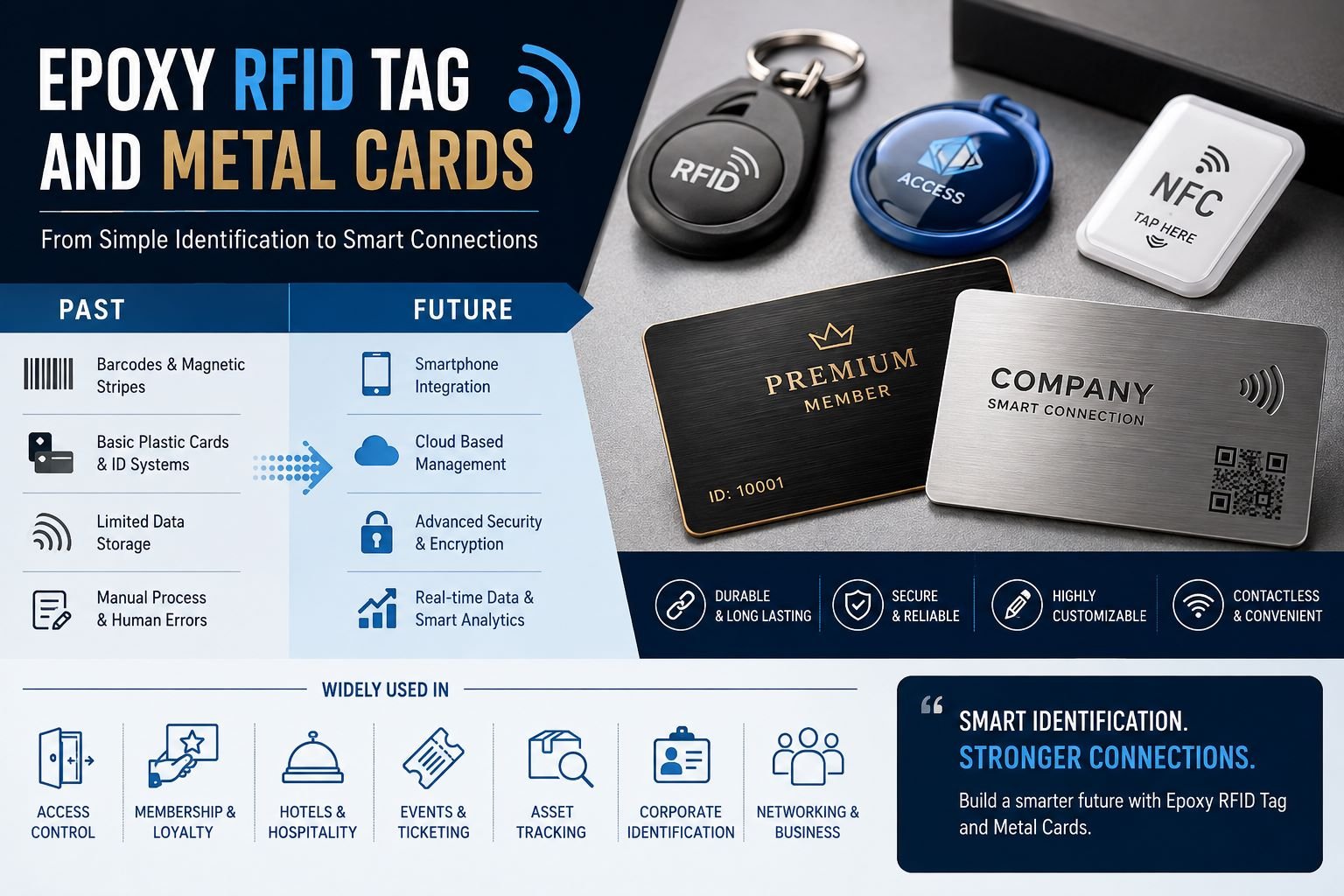
Technology has transformed even the smallest objects we use for identification and communication. A key tag is no longer necessarily just a piece of plastic, and a business card does not have to remain a printed rectangle containing static contact details. Contactless technologies are connecting everyday physical products with digital systems, and the Epoxy RFID tag and metal cards are two strong examples of this evolution.
Their journeys are different. RFID developed largely around identification, automation, and tracking, while premium metal card solutions grew from the need for better durability and stronger brand presentation. Today, these technologies are increasingly meeting in a world driven by NFC, smart access, digital networking, IoT, and connected customer experiences.
Understanding their past helps explain why their future could extend far beyond conventional identification.
Before contactless systems became practical, businesses depended heavily on visual or manually processed identification.
Employees carried printed badges. Warehouses used paper records and labels. Membership organizations issued basic cards. Professionals exchanged paper business cards containing names, addresses, and telephone numbers.
Barcode and magnetic stripe technologies improved these processes, but they still had limitations. Many systems required close alignment, direct scanning, swiping, or manual intervention.
Organizations needed something faster.
Radio Frequency Identification provided an important answer because compatible systems could identify tagged items using radio communication without requiring traditional optical scanning.
Early RFID technology was often hidden inside functional industrial applications. Warehouses, logistics companies, manufacturers, and access-control systems were among the environments where electronic identification demonstrated clear value.
However, functionality alone was not enough for every application.
Businesses also wanted RFID products that could withstand frequent handling while carrying recognizable branding. This requirement helped increase interest in the Epoxy RFID tag.
The protective epoxy surface offered a polished appearance while helping shield the printed layer underneath. More importantly, manufacturers could create customized designs suitable for customer-facing environments.
As RFID components became more compact and accessible, applications expanded.
Today, an Epoxy RFID tag may be considered for:
The important development is not simply the tag’s physical appearance. It is what happens after a compatible reader recognizes it.
A single interaction can initiate a digital process within a connected system.
This represents a significant change from older identification methods.
Instead of displaying information for someone to read manually, an RFID-enabled product can communicate with compatible technology. The system can then retrieve associated information, verify authorization, record activity, or perform another configured action.
The Epoxy RFID tag therefore demonstrates how a relatively small physical product can become part of a much larger digital ecosystem.
While RFID was developing around automation, metal cards were emerging primarily through premium branding.
Paper business cards have existed for generations because they are affordable, portable, and easy to customize. Plastic later became popular for memberships, identification, banking, and loyalty programs.
Metal introduced another dimension: physical experience.
The weight and texture of a metal card immediately distinguish it from ordinary paper. Improved manufacturing methods made it possible to introduce engraving, precision-cut details, different surface finishes, customized typography, and distinctive designs.
As a result, metal cards became attractive to professionals and organizations wanting their physical identity to communicate exclusivity and attention to detail.
The modern business card faces one obvious challenge: printed information can become outdated.
A person changes a telephone number, job title, website, office location, or portfolio, and suddenly hundreds of printed cards contain old information.
Digital connectivity offers another approach.
Some metal cards can integrate NFC or work alongside QR codes, allowing users to connect the physical card to a digital destination.
That destination could include a business profile, website, product catalogue, booking page, portfolio, contact information, or professional network.
Instead of viewing the card as the final source of information, businesses can treat it as the starting point of a digital interaction.
Although both can participate in contactless experiences, their traditional purposes differ considerably.
| Factor | Epoxy RFID Tag | Metal Cards |
| Traditional Role | Identification | Premium presentation |
| Common Technology | RFID/NFC | NFC and QR options |
| Major Applications | Access, attendance, tracking | Networking, memberships, branding |
| Customization | Printing, logos, shapes, numbering | Engraving, printing, cutting, finishes |
| Digital Connectivity | Common | Rapidly expanding |
| Typical Format | Compact tag/keychain | Card format |
| Main Advantage | Fast electronic identification | Premium physical experience |
The best solution depends on the intended environment, reader compatibility, required functionality, branding objectives, and budget.
The future of the Epoxy RFID tag is likely to be closely connected with automation.
Modern organizations generate enormous quantities of operational information. RFID can provide a bridge between physical activity and digital records when deployed appropriately.
Imagine an organization where authorized equipment, employees, inventory, and facilities communicate with centralized software.
RFID can contribute to such connected environments by providing reliable identification points.
Future developments may include:
The Epoxy RFID tag could consequently evolve from a simple access token into one component of a connected operational infrastructure.
For metal cards, future innovation is likely to focus on combining physical quality with digital flexibility.
The physical card can remain premium and durable while its connected destination changes according to the user’s needs.
A smart networking card could potentially direct users toward updated contact details without requiring a completely new batch of printed cards.
This model could be valuable for:
Instead of distributing large quantities of disposable cards, professionals could use a reusable physical networking tool for selected interactions.
Future metal cards may connect customers to product demonstrations, appointment systems, digital portfolios, loyalty platforms, event information, or customized landing pages.
The card then becomes part of the overall customer journey rather than merely a way of sharing a telephone number.
Technology alone does not create a memorable product.
Businesses also care about how identification products represent their visual identity.
An Epoxy RFID tag can potentially incorporate custom graphics, shapes, numbers, and logos. Premium cards can offer engraving, specialized finishes, cut-out elements, QR codes, and other design treatments.
This combination of branding and functionality is important because organizations increasingly want technology that fits naturally into their customer experience.
An Epoxy RFID tag is an RFID-enabled identification product with a protective epoxy surface and customizable exterior design.
They can support access control, memberships, loyalty programs, attendance, events, hospitality, and asset identification.
Yes. Available customization may include logos, graphics, numbering, QR codes, colors, and different shapes.
Metal cards are premium cards manufactured using metal materials for business, membership, identification, or branding applications.
They provide a distinctive physical appearance, durability, and premium presentation compared with conventional paper cards.
Certain specially engineered metal cards can integrate NFC technology for compatible contactless interactions.
NFC is a short-range wireless communication technology commonly used for contactless interactions between compatible devices.
It can serve as an identification credential within a properly configured RFID access-control system.
The physical card can be reused, while connected digital information may be updated depending on the supporting platform.
IoT adoption, cloud platforms, automation, mobile compatibility, security, customization, and data-driven operations will influence future development.